gren-format-lib
The comment algorithm
How gren-format places comments — the implementation, for people who work on
the formatter.
This is the companion to How gren-format places your comments, the reader-facing document: what the parser hands over, the decide-once model, and the normative rules C1–C7 with a before/after for each. This one answers the next question: how, and — more to the point — why we believe it handles every case.
If you are not extending the formatter, read commentHandling.md instead. It tells the same story at a quarter of the length, without the function names, the war stories or the gate numbers. This document is the full reference underneath it.
It is written for someone who has never touched this codebase. It assumes you have read How the formatter works and know what the Logical Printing Tree (LPT) and the Box tree are. If you are adding a new construct, read addingSyntax.md as well — it has the checklist; this document has the model behind it.
Table of contents
- 1. The problem
- 2. The one idea
- 3. The pipeline
- 4. Stage 1 — attachment
- 5. Stage 2 — rendering
- 6. The three state machines
- 7. Runs: any number, any kinds
- 8. Why this covers every run — the argument, not the test suite
- 8.1 Placement is prefix-determined, so n is never an input
- 8.2 The per-comment answer set is finite, and the classifier is total
- 8.3 “Any kind” means three kinds, not an open axis
- 8.4 Every local rule reads at most one neighbor
- 8.5 Where one neighbor is not enough
- 8.6 The fixed point, restated for runs
- 8.7 The anchor — the obligation this argument does not discharge
- 9. An example
- 10. Coverage: what each gate actually varies
- 11. The functions to be careful about
- 12. Debugging a comment bug
- 13. Where the rules genuinely run out
1. The problem
1.1 What the formatter is actually handed
gren-format does not have its own parser. It uses the production Gren
compiler’s parser (gren-lang/compiler-common), and that parser does what
every compiler’s parser does: it throws comments away. They are not nodes in
Src.Module. There is nowhere in the AST for them to be.
What comes back instead is a second, parallel output — the parse Context —
holding a flat, source-ordered list of located comment strings:
type Comment
    = Line String     -- `-- like this`, text after the `--`
    | Block String    -- `{- like this -}`, text between the delimiters

-- and the context carries: Builder (Located Comment)
-- where `Located` is a start (row, col) and an end (row, col).
That is the entire input. For this source (S.gren):
module S exposing (sizes)


sizes =
    [ 1 -- one
    , 2
    ]
the formatter receives an AST for sizes = [1, 2] and, separately, this —
which you can print for any file with --pre-context:
{ "comments": [ { "type": "line", "value": " one",
                  "start": { "row": 5, "col": 9 },
                  "end":   { "row": 5, "col": 15 } } ] }
Nothing connects the two. The comment does not know it is inside an array; the
array does not know a comment exists. All the algorithm has to work with is that
(row, col) pair and the row ranges of the tree it is placing the comment into.
Re-attaching them is this algorithm.
Contrast with elm-format. elm-format’s parser is its own, and it builds comments into the AST — an expression node physically holds the comments written around it. It never has to solve this problem, and much of its comment code has no counterpart here. We take the opposite trade: we are always parsing exactly what the compiler parses (a formatter that accepts a different language than the compiler is a bug factory), and we pay for it with the re-attachment pass described below. This trade is discussed at length in addingSyntax.md.
1.2 What “correct” means here
Three properties, and all three are gated (§10):
- Preservation. Every comment in the input appears exactly once in the
output, with its text unchanged and its kind unchanged.
gren-formatnever edits comment text. (It does re-indent the continuation lines of a multi-line{- … -}; that is layout, not text.) - Faithful placement. The comment lands beside the code the author wrote it beside — rules C1–C7 in commentHandling.md.
- Idempotency.
format(format(x)) == format(x), byte for byte. Formatting is a fixed point.
Property 3 is not a nicety. gren-format runs in editors on save and in CI. A
file that alternates between two spellings produces phantom diffs for ever, and
“the formatter is unstable” is the fastest way to lose a team’s trust in it.
1.3 Why the fixed point is the hard half
Here is the whole difficulty in one picture. The formatter decides where a comment goes by looking at the row and column the author wrote it on — that is the only signal it has. But formatting moves code onto different rows. So the second format asks the same question of different evidence.
Concretely, the recurring failure looks like this:
you wrote:                  format¹ produced:        format² produces:

v =                         v =                      v =
    fn a b {- c                 fn a b                    fn a b
   second -}                    {- c                 {- c
                                   second -}            second -}
Format¹ read “the comment is on the declaration’s last row” and rendered it at the call’s indent. But a multi-line comment cannot sit on that row — it brings its own newlines — so it landed below the declaration. Format² now reads a comment written below a declaration, which is a different question with a different answer (detach to column 1), and the file has two spellings.
Every comment bug this project has fixed is a variation on that sentence: a placement decided from a fact the formatting itself invalidates. Keep it in mind; §4 and §5 are largely a catalog of the places where that can happen and what each does about it.
(That particular shape is fixed — today’s format¹ emits the column-1 form
directly, which is detachOwnLineTrailer’s whole job; see §4.6. It is shown
here because it is the archetype, and because the general strategy it forced
is the subject of the next section.)
2. The one idea
2.1 CommentRole
Every comment’s placement is decided exactly once, in the Logical stage,
while the source rows are still the author’s, and the answer is stored on the
comment leaf as a CommentRole. The renderer reads the stored answer. It never
recomputes it.
type CommentRole
    = TrailsPrevious   -- glue onto the previous sibling's last rendered line
    | LeadsLine        -- own line, at the current flow/body indent
    | LeadsNext        -- belongs to the sibling AFTER an unrecorded separator
    | TrailsHead       -- glue onto the container's head (a record update's base)
    | RidesInline      -- rides mid-line without breaking it (`f {- k -} x`)
    | LeadsInline      -- glued to the FRONT of a declaration (`{- c -} import Qux`)
    | Standalone       -- a detached top-level comment, its own column-1 node
The full docstring lives beside the type in
src/Formatter/Logical/LogicalPrintingTree.gren and is the normative statement
of what each role means; do not restate it elsewhere, extend it there.
You can see the roles for any file:
node ../gren-format/app --lpt MyFile.gren # JSON; each comment leaf has "role"
Here is one file exercising all seven. (Every example in this document was
produced by running the formatter; this one’s roles are --lpt’s own output.)
module Ex exposing (a, b)

{- c -} import Qux

import Dict {- inline -} as D

a rec =
    { rec -- about the base
        | alpha = 1
    }

b =
    let
        base =
            -- start here
            1
    in
    [ base -- the seed
    , 2, {- two -} 3
    ]

-- detached below b
| comment | role |
|---|---|
{- c -} before import Qux |
LeadsInline |
{- inline -} in import Dict … as D |
RidesInline |
-- about the base |
TrailsHead |
-- start here |
LeadsLine |
-- the seed |
TrailsPrevious |
{- two -} |
LeadsNext |
-- detached below b |
Standalone |
2.2 The barrier
The corollary of “decided once” is a hard architectural rule:
No code under
Formatter/Render/may read a source row or position to make a layout or comment-placement decision.
Placement is the stored CommentRole. Verticality is the rendered box shape
(isSingleLine on a box that has already been built), never “did the author
span rows”. The renderer’s remaining questions about a comment are about its
text — can this text share a line? — which is a property of the string, not
of where it sat.
This is enforced by the type checker, not merely documented.
Formatter.RenderTree.lower strips the LPT’s seven cached position fields, and
every module under Render/ takes the resulting RenderNode: there is no row to
read, so a new render-side row read does not compile. The handful of decisions
that genuinely needed the author’s rows are precomputed there as booleans
(rnSharesRowWithPrevItem, rnHasSourceContent, rnVariantsSpanRows,
rnTypeSegmentsBroken). RenderShape strips the Located payloads too, so
there is no position anywhere in the renderer’s view of the tree and no script
left to check for one. A new render-side row read is almost always a regression
back toward the oscillation class above – and now it simply does not compile.
Where a renderer does need to know something structural about a comment, it
asks a predicate that reads LPT shape and comment text only —
NodeClassify.commentEndsItsLine, commentTextCanRide,
subtreeEndsWithMultilineBlockComment. Each of those docstrings says explicitly
that it reads no rows, because that is the property that lets it live in
Render/. Better still is a fact the rendered box carries, which no predicate
has to mirror: see B.endsOpen in §5.2.
3. The pipeline
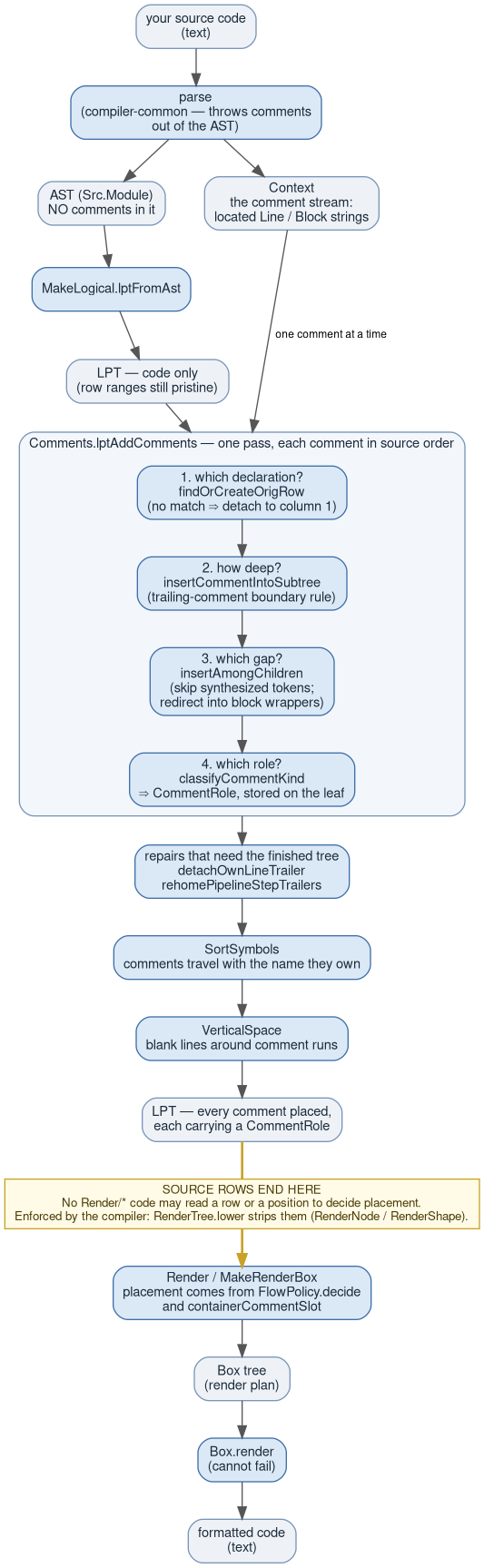
(Source: docs/diagrams/comment-pipeline.dot; regenerate with
docs/diagrams/generate.sh, which needs graphviz.)
In words:
MakeLogical.lptFromAstbuilds the LPT from the AST alone. At this point there are no comments in the tree, and every node’s row range is exactly what the author wrote.Comments.lptAddCommentsfolds over the comment stream in source order, placing each one. Four phases per comment (§4.2–§4.5), plus one re-decision for the neighbor a new comment has just joined in a gap (repairTornGapRun, §7’s R2).- Two repairs run over the finished tree, for placements that only become wrong once you can see the whole thing (§4.6).
SortSymbolsreorders exposing lists and import groups — comments have to travel with the names that own them (§4.7).VerticalSpaceinserts blank lines, which is a comment question too: a comment run is a unit and the gap belongs to the run, not to its first member (§4.7).- Everything below the barrier renders from stored roles (§5).
4. Stage 1 — attachment
All of this is src/Formatter/Logical/Comments.gren. It is the single largest
module in the formatter (~3,000 lines), and roughly two thirds of that is
docstrings explaining why a branch exists. Read them; nearly every one names the
shape that broke without it.
4.1 The fold
The entry point:
lptAddComments : Ctx.Context -> LPNode -> LPNode
It folds addOneComment over the comment stream, threading a CommentState:
type alias CommentState =
    { settled : Builder.Builder LPNode   -- root children no later comment can reach
    , target  : Maybe LPNode             -- the one that might still receive comments
    , rest    : Array LPNode             -- everything after `target`
    }
This shape is a performance fix, and it matters on real files: comments arrive
in row order and the root’s children are already in sorted, non-overlapping row
order, so once a comment’s row passes a child, no later comment can reach that
child again. Retiring it into settled (an Array.Builder, amortized O(1))
makes the whole sweep O(n + m) instead of O(n²) on a file that is mostly
top-level comments.
addOneComment has one special case before the generic path:
tryLeadingGluedAttach, which recognizes a block comment glued to the front
of a top-level declaration — {- c -} import Qux — and attaches it as a leading
child with role LeadsInline. It keys on the comment’s end row (so a
multi-line comment whose last row carries the keyword is recognized too), where
everything else keys on the start row. Getting this wrong doesn’t just misplace
the comment: a comment that fails to travel with its import breaks an import run
in two when the imports sort.
Everything else goes through addCommentGeneric → the four phases.
4.2 Phase 1 — which declaration?
findOrCreateOrigRow row stype children
The root’s children are one OriginalRows node per top-level declaration, each
carrying a { first, last } source-row range. Scan for the one whose range
covers the comment’s row.
If none does, the comment detaches: a fresh OriginalRows at column 1 is
spliced in at the sorted position, and the comment’s role is preset to
Standalone.
That is a deliberate choice, not a fallback. A comment written on its own line
below a declaration is never attached to that declaration. Why:
column 1 is trivially a fixed point — it cannot drift — whereas any rule that
claims such a comment for the construct above has to place it at some indent,
and then re-derive the same claim from an indent that formatting has moved. An
earlier design did exactly that (a columnClaim rule) and it drifted leftward a
few columns per format. elm-format detaches these too.
-- you write:
b =
    1
    -- detached below b


c =
    2
-- gren-format writes (column 1, and stays there for ever):
b =
    1
-- detached below b


c =
    2
4.3 Phase 2 — how deep?
insertCommentIntoSubtree commentNode row col node
Recursive descent. At each level, pick the deepest child that owns the comment:
childOwnsComment =
    childHasBody
        && (((subtreeContainsRow child row || elasticTailOwnsComment)
                && not (subtreeStartsAfter child row col)
            )
                || commentAfterBracketOpen
           )
        && not laterSiblingClaims
        && not trailingCommentEscapes
Four questions, and each one is a class of bug that was found the hard way:
subtreeContainsRow/subtreeStartsAfter— plain row containment, plus “a child that starts after the comment is never its owner”. Row containment alone is not enough because sibling subtrees routinely overlap on a row.laterSiblingClaims(anyLaterSiblingStartsAtOrBefore) — if a later sibling’s first real token is at or before the comment, this child’s apparent overlap is a false positive and the comment really sits between the two. The canonical shape is two record types straddling a->in a signature.commentAfterBracketOpen— a comment written just past a[/{([ {- c -} 1, 2 ]) looks like it comes before the container, because a bracket has no leaf of its own and the subtree appears to start at the first item. The recorded opening position (lpnBracketStart) is what says otherwise. Only a bracket and a binary operator carry a recorded position in the Gren AST; everything else the parser discards (see §4.5). So “inside or outside this container” is one of the few things we genuinely know rather than choose.trailingCommentEscapes— the inner half of the trailing-comment boundary rule, below.
The trailing-comment boundary rule
This is the single most important rule in the descent, and it is the direct answer to §1.3.
A comment that merely trails a node’s last token must not be sucked inside that node — it belongs beside the node, at the enclosing level. The rest of this section is why, since “it would oscillate” is an assertion until you can say what forces the move.
When does this even come up? The guard fires in one specific situation:
the comment’s row is inside the child’s row range, but the comment sits past
the child’s last token. Given that ranges are min..max rows, that means the
comment was written on the child’s last row, after everything on it — the
one place where “inside this node” and “after this node” are both readable.
Here is that shape. A parenthesized lambda, with a multi-line comment written on the body’s row:
-- you write:
b =
    (\q ->
        body q {- c
   second -}
    )
-- gren-format writes (the comment belongs to the PAREN — it renders below the
-- body, at the paren's own column, which is `(`+1):
b =
    (\q ->
        body q
     {- c
        second -}
    )
The alternative — the one the guard rules out — is to let the comment descend
into the lambda body it was written on, which would render it a level further in,
at body’s column.
Why format² cannot simply keep that
The natural objection is: so what? If format¹ puts the comment at the body’s column, why can’t format² just leave it there?
Because format² does not keep anything. It has no memory of format¹ and no
record of what owned the comment. It re-derives every placement from the text in
front of it. So the real question is whether that text still contains the
distinction — and it does not. Once the comment is on a row of its own, the only
surviving trace of “this belonged to the lambda body rather than to the paren”
is the comment’s own indentation, and indentation is not an input to
placement. That is not incidental; it is a separately gated property of this
formatter (fuzz-whitespace.py: format(perturbed whitespace) ==
format(original)).
You can watch that directly. Feed the formatter the same comment at three different columns — the paren’s, the lambda body’s, and one that means nothing at all:
-- A: at the paren's column
b =
    (\q ->
        body q
     {- c
        second -}
    )
-- B: at the body's column — i.e. exactly what "descend into the lambda" emits
b =
    (\q ->
        body q
        {- c
           second -}
    )
-- C: at no meaningful column at all
b =
    (\q ->
        body q
                    {- c
                       second -}
    )
All three format to byte-identical output, and that output is A. B is exactly what the descending version would have emitted, and it formats straight back to the paren’s column. This is not a prediction about what format² would do; it is the shipped formatter, and it takes ten seconds to re-run:
for f in A B C; do node ../gren-format/app --show $f.gren; done # three identical outputs
Note what the three-way collapse proves, which is more than the one case: the
output column here is a function of the structure alone. So it does not
matter what column the descent would have chosen — any placement other than
the one the enclosing structure derives is undone by the next format, and
format(format(x)) ≠ format(x). The boundary rule is what makes format¹ commit
up front to the placement format² is going to derive anyway.
The same argument in one sentence: format² can only keep what it can re-derive, and after the comment takes a row of its own there is nothing left in the file to re-derive “inside the lambda” from.
The same rule, without any oscillation
Not every case of this is about idempotency. RecordUpdate is on the
never-swallow list for a plainer reason:
-- you write, and gren-format keeps (the comment is about the record):
v =
    fn a { r | x = 1 } {- note -} b
The comment sits past the }, on the record’s last row — the guard’s exact
trigger. Before RecordUpdate was on the list, this descended and rendered as:
v =
    fn a { r | x = 1 {- note -} } b
A note about the record, migrated inside the braces, where it now reads as a note about the field.
And that output is perfectly stable. Feed it back to today’s formatter and it comes out unchanged, exit 0 — meaning it parses, preserves the AST, and is its own fixed point. Every idempotency gate in this repo passes it. It is simply wrong, under rule C1: the author wrote the comment outside the braces and the formatter moved it in.
So the boundary rule is not only an idempotency device. Half of what it protects is meaning, and that half is invisible to every gate that compares the formatter against itself — which is why §10’s coverage argument leans on the elm-format oracle and the generator’s oracles, not just on the fuzzers.
Three tests make a comment stay outside:
| test | what it catches |
|---|---|
shapeKeepsTrailingCommentOutside child |
shape kinds that must never swallow a trailing comment |
nextSiblingIsBoundary |
the next sibling starts a new flow item — in, else, the next let binding (IndentedBlock), the next when branch (WhenBranch) |
containerTailKeepsCommentOutside |
a multi-line comment past the last thing a paren wraps, or past any item of a bracketed container: it belongs to the container, not to that item |
shapeKeepsTrailingCommentOutside is the single declared list of such shape
kinds. If you add a construct that needs this rule, add it there rather than
threading a new predicate into the guard:
| shape kind | why |
|---|---|
AcrossOrVertical |
a function-call / argument flow |
IfCondition |
an if / else if condition |
PrefixGlue |
a \-glued lambda head or a unary - — matters even mid-flow, where the next parameter’s flow separator would otherwise shift that parameter by a column |
ParenBlock |
a parenthesized expression |
AllAcrossOrAllVertical / AlwaysVertical |
a bracketed item list: a comment past the closing bracket is a sibling, not an item |
RecordUpdate |
{ base \| f = v } and the extensible record type — same rule as the bracket lists |
Note what nextSiblingIsBoundary is not: it is deliberately not “any
following sibling”. A container followed by a continuation — a record type
before its -> — also has a following sibling, but a comment before that
record’s } belongs inside it. Widening the test reintroduces
non-idempotency; this was tried.
The exception: still inside the brackets
commentInsideTrailingBracket overrides all of the above. A comment written
before a container’s closing bracket genuinely belongs inside it, and it
descends:
fn a { r | a = 1 {- c -} } b     -- the comment is on the field: it descends
fn a { r | a = 1 } {- c -} b     -- the comment is on the record: it stays out
For this to work, a container whose closing delimiter the parser discards must
register it with lpnBracketNode <closePos>. This is the number-one thing to
get right when adding a construct. An author-written paren around a type went
years without one, and a comment before its ) escaped the parens and then
landed on the far side of the -> on reparse — a genuine non-idempotency, fixed
by registering the bracket.
Elastic containers
Some closes have no authored position at all because their column is derived.
The module header’s exposing ( … ) is the case: its ) renders below whatever
the list holds. Those register with lpnElasticBracketNode, and two things
follow:
elasticTailOwnsComment— an elastic container with nothing after it owns every comment that got this far, on any row. Row containment would leave a comment written on the row below a flat list outside it, where it renders glued onto the header; reparsing that puts it back inside. Same shape, both spellings, one answer.lpnExtendElasticBracket— placing a comment inside grows the derived close below it, andapplyCommentToOrigRowgrows the declaration’s own row range to match. Without that, the next comment of a trailing run reads as past the declaration and detaches to column 1 while its neighbor stays put.
An effect module’s where { … } block has a second derived close, recomputed by
moduleWhereCloseRow for the same reason. It is deliberately not elastic:
“anything reaching this container is inside it” is true of the exposing list
(nothing follows it) and false here, because exposing (..) does.
4.4 Phase 3 — which gap?
insertAmongChildren containerShape commentNode row col children
The descent has settled on a node; now, between which two of its children does
the comment go? Count how many children end before (row, col) — then apply
three adjustments:
a. Skip synthesized tokens. Nodes the parser never gave a position
(SynthesizedText: a generated ->, the in of a let, else) are invisible
to ranges, and a comment must never be spliced between a real token and its
synthesized neighbor. The skip walks forward over them.
This skip is what carries a comment trailing the last let binding past the
position-less in, down to the body column:
-- you write:
f =
    let
        a = 1
        -- after the last binding
    in
    a
-- gren-format writes (the comment lands below `in`, leading the result):
f =
    let
        a =
            1
    in
    -- after the last binding
    a
That is a deliberate divergence from elm-format, not a gap. in has no
position, so “before in” and “after in” are literally the same input;
scoping the skip to keep the comment with the bindings makes it oscillate
(verified: same-row → own-line at the binding indent → reparses as no-longer
same-row → back to the body column). Below in is the only stable-and-correct
rule.
b. The BodyBlock guard. “Position-less” is judged by lpnLastPos,
with one exception: a BodyBlock is never skipped. A BodyBlock wrapping an
empty value ([], {}) has a real opening position but no last position, so
it looks skippable and a leading comment sails past the value to render
[] {- note -}. If that value later gains an inside comment it becomes
non-empty and absorbs the stranded one on reparse.
c. Redirect into block wrappers. If the comment lands immediately before a wrapper that starts its content on a fresh line, push it inside as the first child, so it renders at the body’s own column instead of gluing onto the head:
| wrapper | redirected? |
|---|---|
IndentedBlock (a let binding’s value, a when branch’s body) |
always — except inside a bracket container |
BodyBlock as a declaration’s value (isDeclValueContainer) |
always |
BodyBlock elsewhere (an array item, a step body, a call argument) |
only when the comment cannot ride the row |
PipelineStep |
only when the comment cannot ride the row |
SoftIndentedBlock (a lambda body on the -> row) |
only a -- |
The split in the last three rows is rule C3 — a comment never forces a
break. seed |> f |> g stays on one row, so a {- c -} written between the
seed and the operator has a flat line to ride and belongs on it. Redirecting it
inside made it the step’s first child, where nothing precedes it, so it
classified LeadsLine and forced the whole chain vertical — line breaks the
code never needed. The SoftIndentedBlock row is the mirror: a -- does end
its line, the body is forced onto the next row regardless, and a reparse reads
that as an IndentedBlock — whose arm redirects. So leaving the -- outside
emits a shape that reparses into the other structure and moves.
Read those arms as one rule: redirect exactly when the body cannot share the head’s row anyway.
The bracket exception in the first row is that rule again, and it is worth
reading because the arms state their premise as a fact about the shape when it
is really a fact about the container. “This body always starts a line of its
own” is true of an IndentedBlock holding a let binding’s value and false of
the same shape holding a record field — folderInsertRecordField builds a
lambda-valued field as an IndentedBlock, and inside a bracket that shape is an
item, which renders after the container’s , . Redirected inside, a comment
written in the , gap stacked above fld =; the reparse read it as own-line and
moved it in front of the separator, for ever. Every other field shape had always
rendered it , {- c -} fld =. The same premise error one constructor over is
what the BodyBlock row’s isDeclValueContainer gate exists for.
4.5 Phase 4 — which role?
classifyCommentKind containerShape commentNode before after row -> CommentRole
The splice point is known and the neighbors are in hand. This is where the placement is decided, and the criterion for the decision is stated in the function’s own docstring:
A
CommentRoleis a reparse fixed point: the row it is decided from equals the row it renders on, so a reformat re-derives the same role.
Every branch here should be read against that sentence.
The unrecorded-separator problem (rule C2)
Of everything that can separate two pieces of an expression, only a binary operator and a bracket survive parsing with a position. All of these are gone:
=    :    |    ,    ->    if / then / else    when / is    let / in
an import's `as` and alias name
So x {- c -} = y and x = {- c -} y arrive as the same three facts: where
x ends, where the comment is, where y starts. The formatter cannot tell them
apart, and it must not look at whitespace width (formatting must not depend on
your spacing). One of the two spellings has to move.
The rule is: the comment lands after the separator, not before it — role
LeadsNext. Making that a stored role, rather than a thing each renderer
re-derives, is what stops a comment from flipping sides of an invisible ,
between formats.
C2 has one documented exception and three documented preferences, all in
commentHandling.md.
The exception, in code, is leadsAcrossItemSeparator: it applies only to a
single-line {- -}. A -- ends its row, so it reads as a note about that
row, and at a line-leading separator (,, a union’s |, a record update’s
|) a comment above one strands nothing. [ apple -- the red one ⏎ , banana
is the idiom real code uses — unanimously, in core/ and compiler-common/ —
and is also what elm-format emits.
The three branches
classifyCommentKind dispatches on the container, because the glue rule
differs by container and the differences are real:
container is a bracket list / record update   →  the permissive rule
container is a binop chain (Binop / OpAndRhs) →  the operand rule
anything else (the generic flow)              →  the coarse rule
- Bracket branch (
isBracketContainerShape) — permissive: a comment on the same row as the previous item trails it, whatever kind of item that was; a line-leading one stands on its own line. These comments render throughcommentBracketListBox, never through the generic flow, so they get their own branch. The record update is a sub-case with its own arm, because its children are its fields — the base name is not a child at all, so a comment beside it needsTrailsHead, and the base’s recorded position is what separates the opener slot ({ {- c -} rec) from the ambiguous|slot. - Binop branch — a same-row comment trails the operand; a later-row one
leads its own line at the operator indent. “Later row” is measured from
chainedRefRow, not from the last operand: the last operand’s row grown through any comment run written on from it, because a multi-line{- … -}closes several rows below its{-and what the author wrote after that-}sits beside it, not on a line of its own. - Generic flow — the coarse rule, split by comment kind:
classifyLinefor a--andclassifyBlockfor a{- -}, each consulting a per-shape-kind table of “what row does a following comment glue onto”:prevLineGlueRowandprevBlockGlueRow.
Here is the whole function as a decision tree, in two halves — the branch
dispatch plus the two simpler branches first, then the bracket branch. Every
leaf is a CommentRole.
Half 1 — the dispatch, the binop branch, and the generic flow:
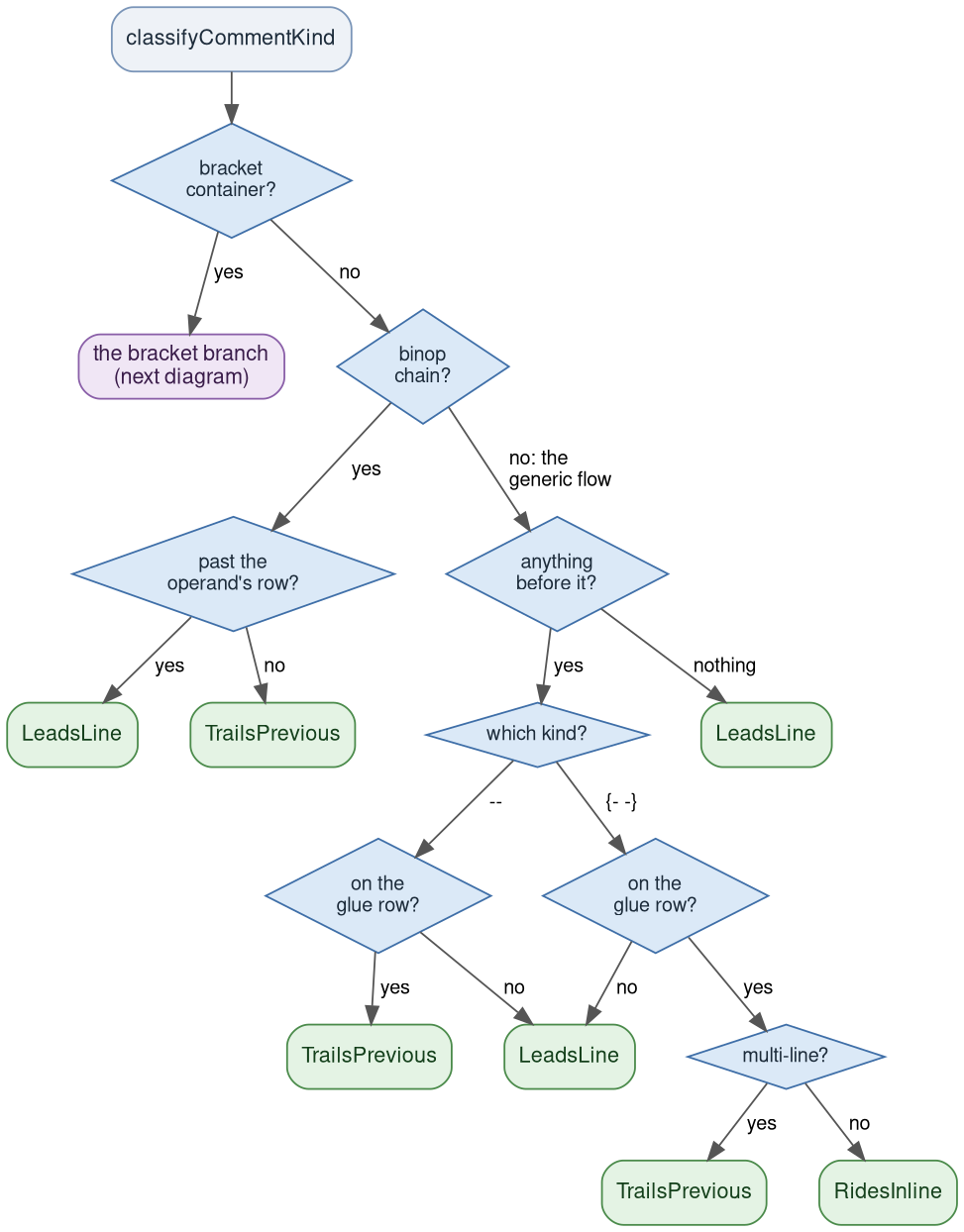
The diamonds, in code terms:
| in the diagram | in Comments.gren |
|---|---|
| bracket container? | isBracketContainerShape containerShape |
| binop chain? | containerShape is Binop _ or OpAndRhs |
| past the operand’s row? | row > chainedRefRow — the last non-comment operand’s row, grown through any comment run written on from it |
| anything before it? | before is non-empty (prev) |
| which kind? | SingleLineComment → classifyLine, BlockComment → classifyBlock |
on the glue row? (--) |
row == prevLineGlueRow prev, or the previous node is elided, or headerTailGlue |
on the glue row? ({- -}) |
row == prevBlockGlueRow multiline prev, or headerTailGlue (single-line only) |
| multi-line? | the comment’s own text contains a newline |
Half 2 — the bracket branch:
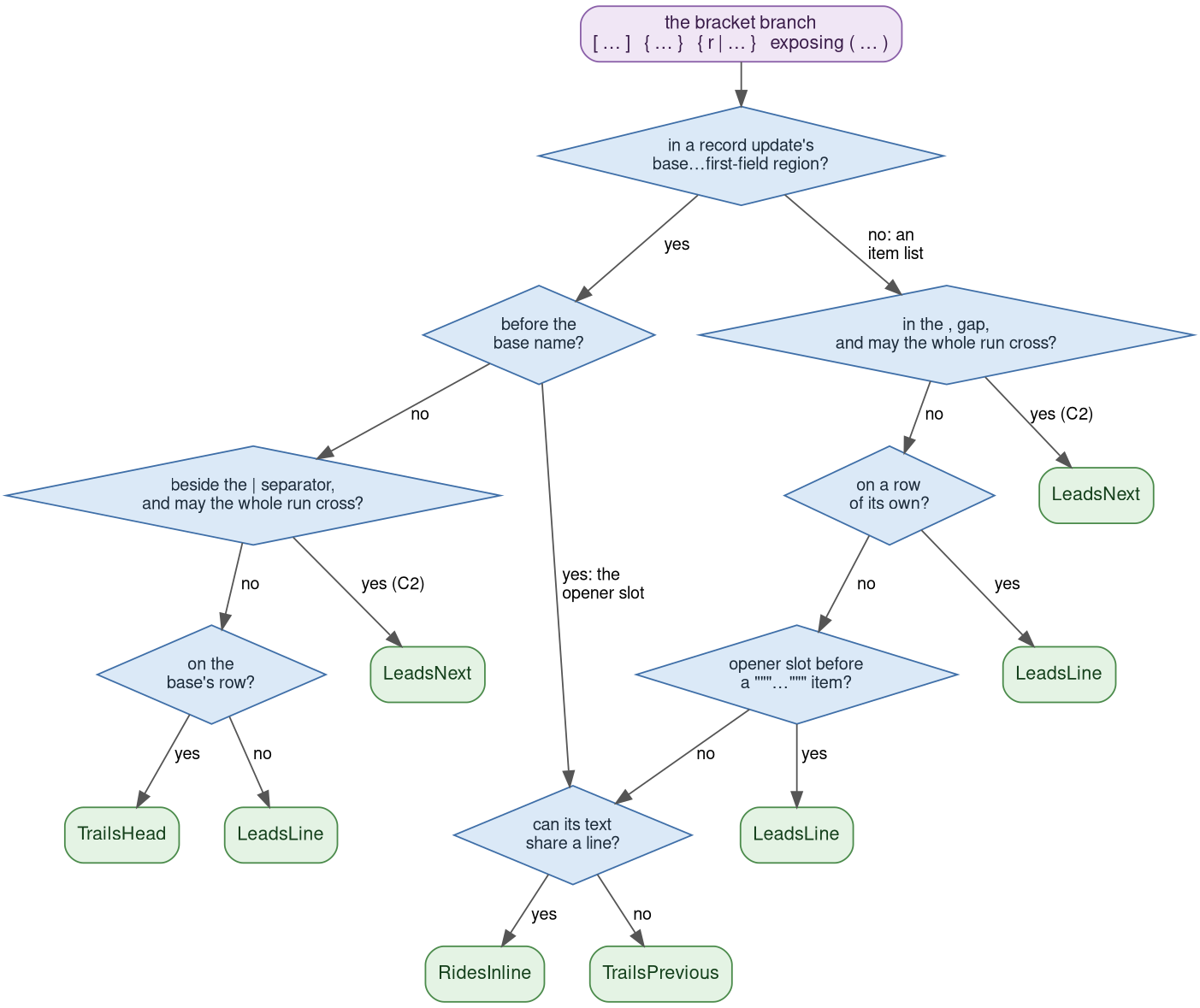
| in the diagram | in Comments.gren |
|---|---|
| in a record update’s base…first-field region? | isRecordUpdateShape containerShape && Array.all isCommentNode before |
| before the base name? | commentPrecedesUpdateBase — the base’s start position is recorded, so this is a fact, not a guess |
beside the \| separator, and may the whole run cross? |
leadsAcrossUpdateSeparator — a single-line {- -} on the base’s row or the first field’s row, and gapRunCrossesTogether |
| on the base’s row? | row == updateBaseRow |
in the , gap, and may the whole run cross? |
leadsAcrossItemSeparator — a single-line {- -} on the previous item’s row or the next item’s row, and gapRunCrossesTogether; never in an exposing list |
| on a row of its own? | bracketPrevRow < 0 \|\| row /= bracketPrevRow (bracketItemRow keys a previous comment by its last row) |
opener slot before a """…""" item? |
Array.isEmpty before && nextItemBlocksFrontGlue — front-gluing there would break the string’s equal indentation and stop the output parsing |
| can its text share a line? | bracketKindRole — a single-line {- -} can; a -- or a multi-line {- … -} cannot |
Two roles never appear as leaves here, because they are decided before this
function runs: Standalone (findOrCreateOrigRow, when no declaration’s row
range covers the comment) and LeadsInline (tryLeadingGluedAttach, a block
comment glued in front of a declaration).
(Sources: docs/diagrams/comment-classify-flow.dot and
comment-classify-bracket.dot.)
Four things to read off them:
- Every path ends in a role. There is no fallback, no “unknown”, and no branch that defers to the renderer. That totality is what §2.1’s “decided exactly once” means in practice, and §8.2’s half of the completeness argument.
- The two C2 diamonds are the only ones that ask about the comment’s
neighbors rather than about the comment.
gapRunCrossesTogetheris the conjunct that makes them all-or-nothing over the run (§7’s R2); everything else on both diagrams reads this comment’s own position, kind and text. - Every row test in them is the same question — is the comment on the row the
thing before it ends on? — and the branches differ only in how that row is
computed:
bracketItemRowin a bracket list,chainedRefRowin a binop chain,prevLineGlueRow/prevBlockGlueRowin the generic flow. (Rule C2’s arms ask it of the row after the separator as well, which is what makes them stable in both authorings.) This is the last time a source row is consulted for this comment — everything downstream reads the role. - The kind is never the question of which code owns it. That is settled by position, in phases 2 and 3, before this function runs. Kind decides only whether the comment can share the owning code’s line — and where that does move a comment (the block-wrapper redirects of §4.4c), it is because “can it share the line” is precisely what is at stake there too.
The two glue-row tables the generic flow consults — prevLineGlueRow and
prevBlockGlueRow — are the heart of the coarse rule, and the difference
between them is the whole point:
                                  --  glues?   {- -} glues?
after a bare token                 yes          yes
after a plain call `foo bar`       yes          NO   (stays own-line)
after a single-line bracket        yes          NO
after a multi-line bracket's close yes          yes
after a `"""…"""`                  yes          yes
after a lambda head                NO           NO
A -- runs to end-of-line, so it is unambiguously trailing and glues in
strictly more places than a block comment can. This asymmetry matches
elm-format, and it is why foo bar -- c is a fixed point while foo bar ⏎
{- c -} is too.
Both tables key a previous comment by its last row, not its first, so
that a comment written after a multi-line comment’s -} trails the run instead
of leading whatever is below.
The header’s position-less tail
One branch deserves its own note because it looks like a special case and is
not: headerTailGlue. An effect module’s header renders tokens — the where
{ … } block’s }, the exposing (..) after it — that carry no position at
all, because their real column depends on the untracked width of the block. A
comment the author wrote on those rows has no recorded token anywhere on its
row, so the ordinary rule reads it as own-line while the format that produced
that row had glued it.
The fix widens the fallback from one row to the header’s whole position-less tail, under three conditions, each of which is necessary (the container is the module line; nothing recorded follows except the exposing list; the row is at or past the last recorded content and inside the declaration). It is scoped to single-line comments, since only those can ride a header row at all.
The general lesson: wherever the renderer emits a token the parser did not record, a comment on that token’s row is a placement question rows cannot answer. Look for the structural fact instead.
4.6 Repairs that need the finished tree
Two repair passes run at the end of lptAddComments, in that order. They exist
because their questions cannot be answered while placing one comment: they are
about what the rendering will look like, which you only know once every
comment is in.
Neither is a walk of the whole tree. detachOwnLineTrailer is applied to each
top-level child and descends only the one spine peelOwnLineTrailingRun
follows; rehomePipelineStepTrailers recurses through the subtree but does work
only at a Pipeline node. The order between them is load-bearing, for the
reason given under the second.
detachOwnLineTrailer — §4.2’s rule, asked of the tree instead of the rows.
findOrCreateOrigRow refuses a comment written on a row below a declaration.
But a comment written on the declaration’s last row escapes that check — its
row is inside the range — and can still render below it, because a multi-line
{- … -} with no glue row classifies LeadsLine and takes a fresh line.
That is exactly the §1.3 oscillation. So: once everything is placed, lift any
trailing run that renders own-line into the same column-1 OriginalRows the
reparse would give it. Format¹ builds the tree format² would build.
-- you write (the comment starts on the declaration's last row):
v =
    fn a b {- c
   second -}
-- gren-format writes (lifted to column 1 — and formatting it again is a no-op):
v =
    fn a b
{- c
   second -}
Its scoping is as important as its existence:
- The lift is a suffix, not the whole run.
peelOwnLineTrailingRunsplits at the earliest member that renders below the declaration and leaves everything in front of it where it was written. A run’s leader can perfectly well glue onto the declaration’s last row while a later member cannot, so asking the question of the leader instead keeps a whole run glued behind a leader that glues. (firstRowOfItsOwnis the scan that finds the cut; it is one of the three run state machines in §6.) - The split has to live in the peel rather than in the caller, because the run is collected by descending through each node’s last child: a kept prefix could not be put back afterwards without re-nesting comments the descent had already lifted out.
- Two things make a member render below, and they are different questions:
runRendersBelowDeclaration(the member brings its own rows —LeadsLineand a genuinely multi-line{- … -}), and the member in front of it is a--, which swallows the rest of its row so everything after it is on a later one whatever its own kind says. AtailCommentfield carries “this level’s tail is a--” up to the level above, which is what the first member of an outer run has to know. - Role alone is not “renders own-line” — the render layer keeps a single-line
block comment inline regardless, which is why
[ 1 ] {- one -} {- two -}stays put. Lifting on the role alone broke nine fixtures. - A
--is deliberately excluded fromrunRendersBelowDeclarationeven though it also ends its row; several fixtures pin a line-leading--staying at the construct’s indent, and whether those should detach is a separate question with its own fixtures. Note it still causes a cut for the member after it — being a reason for somebody else to detach and being detachable are not the same test. - The lifted suffix moves together, and only its first member becomes
Standalone— a-- cglued behind it keepsTrailsPrevious, because that is the tree the reparse produces. descendsForTrailingRunlimits how deep the peel looks: only flow wrappers, ones that render their children and nothing after them. A container that renders a closing delimiter does not qualify — the delimiter is not a node, so “no node after the last child” does not mean “no token after it”.{ rec | fld = x -- c⏎}is the shape that trap was found on.
Each scope is a shape that is already a fixed point where the author put it, so the lift must leave it alone. These three come back byte-identical:
-- a trailing run that GLUES stays on the closing bracket's row (C1: it belongs
-- to the code it was written next to):
a =
    [ 1
    , 2
    ] {- c
         second -}


-- a single-line {- -} renders inline whatever its role says, so it is not
-- "renders own-line" and is not lifted — nor is a second one chained onto it:
b =
    [ 1 ] {- one -} {- two -}


-- and the peel stops at a container that still has a `}` to render, so this
-- comment is the record update's, not the declaration's:
c rec =
    { rec
        | fld = x -- c
    }
(The -- scope has no example here because it is a scoping decision rather
than a shape: a -- that classifies LeadsLine and renders below its
construct is left alone, and the fixtures that pin those live under a wrapped
import and a pipeline’s last step.)
rehomePipelineStepTrailers — a pipeline step’s trailing comment
run renders below its step, which puts it above the next |>; and a comment
on its own row before an operator is, to a reparse, that operator’s step’s
leading comment. There is no other reading available, so format¹ must own it
there too.
This one needs the tree to see, because the repair does not change the
output — that is the whole point of it. Write a multi-line comment after a step
whose operand is a single-line paren (a paren gives a block comment no glue row,
so the comment classifies LeadsLine):
-- you write:
v =
    seed
        |> Array.map (\c -> c.kind) {- multi
   line -}
        |> g
-- gren-format writes (the comment drops to the `|>` column, above the next step):
v =
    seed
        |> Array.map (\c -> c.kind)
        {- multi
           line -}
        |> g
Now ask the tree who owns it. This is --lpt’s JSON with everything but the
shape types and the comment’s own fields stripped out:
Pipeline
  UnbreakableText 'seed'
  PipelineStep
    UnbreakableText '|>'
    UnbreakableText 'Array.map'
    ParenBlock
      …the lambda…
  PipelineStep
    BlockComment ' multi\n   line '  role=LeadsLine        ← here
    UnbreakableText '|>'
    UnbreakableText 'g'
The comment is the first child of the second step, ahead of that step’s own
|> — not a trailing child of the first step, which is where the author wrote
it. That move is rehomePipelineStepTrailers, and step 2 is the owner a reparse
of the output derives: in those bytes the comment is on its own row before
|> g, and a comment on its own row before an operator is that operator’s step’s
leading comment. There is no other reading available.
The boundary is one operand kind away. Give the step a plain call instead of a
paren and the same comment finds a glue row, classifies TrailsPrevious, and
stays exactly where it was written:
v =
    seed
        |> Array.map fn {- multi
                           line -}
        |> g
Pipeline
  UnbreakableText 'seed'
  PipelineStep
    UnbreakableText '|>'
    UnbreakableText 'Array.map'
    UnbreakableText 'fn'
    BlockComment ' multi\n   line '  role=TrailsPrevious   ← stays in step 1
  PipelineStep
    UnbreakableText '|>'
    UnbreakableText 'g'
This one is worth studying because a renderer-only fix was tried first and was
not enough. Making both owners produce the same bytes for the run left
glueLeading reading a different run in each format — it asks
commentTextCanRide of the whole leading run, all-or-nothing, and with the run
split across two steps format¹ saw only the ridable {- c -} while the reparse
saw both. Same comment, same role, same rendering rule, different answer, for
ever. Making two owners render alike is not the same as making the owner not
matter; the owner also decides what else the comment is grouped with.
4.7 The two passes that run after
SortSymbols reorders exposing lists and import groups. A comment must
travel with the name that owns it, or (a {- c -}, b) and (b, a {- c -}) land
on different bytes — and the same module written in two author orders must
format identically (this is checked by an oracle; §10). takeSameRowTrailing
chains a whole trailing run onto its name; unfoldLastTrailing handles the
closing-) pinning; hoistBracketLeadingComments handles a comment written
before the first item.
Note that an exposing list is the one bracket list whose items get
reordered, and it therefore models comment ownership the opposite way round
from C2 — a comment after a name is that name’s. leadsAcrossItemSeparator
excludes it explicitly.
VerticalSpace inserts blank lines, and its comment-relevant part is
computeDetachedBelow: whether a node has a gap under it. The subtlety is that
detachment is a property of the comment run, not of a node, and has to
propagate up through an adjacent following comment.
-- you write:
{-| doc -} -- c

foo =
    1
-- gren-format writes:
{-| doc -}
-- c


foo =
    1
The two comments are one run, detached from foo, so the run gets the two blank
lines below it. Now look at what each pass sees. The -- c is written on the doc
comment’s row, so on the first pass it is a child of that node and the
node’s own rows cover both — that node can see the gap. Reparsed, the -- c is
its own column-1 node directly below, so the doc comment’s next sibling is
adjacent and the gap belongs to somebody else. Asking per node gives two blanks
and then one; asking the run answers the same either way.
5. Stage 2 — rendering
Below the barrier the job is narrow: a comment’s placement is already decided, so the renderer only materializes it, plus answers the questions that are about the comment’s text.
5.1 The two decision functions
Everything goes through one of two functions in
Formatter/Render/FlowPolicy.gren:
decide— how an item joins a flow (a call’s arguments, a binop chain, a signature). Its input isItemFacts, and that type is deliberately the complete legal input set: anything richer is “not extra precision, it is a divergence generator”. For a comment the facts are its kind and itsCommentRole— no rows.decidereturns aPlacement(GlueSpace,OwnLine,SoftSep,BlockJoin, …) and the next separator state.containerCommentSlot— where a comment sits among the children of a vertical container (a union body’s variants, a record update’s fields, awhen’s branches, a bracket list’s items). Four answers, in priority order:LeadsOpener,LeadsFollowing(rule C2),GluesPrevious,StandsAlone.
containerCommentSlot was extracted in August 2026 from four hand-written
if-chains that agreed only by inspection — one of them said so in a code comment
(“mirrors commentBracketListBox’s pending”), an invariant asserted in prose
and enforced by nothing. The four containers still materialize the answer
differently (a when stacks its lead run and separates branches with blank
lines; a bracket list glues the run onto the item’s front behind a , prefix;
a union body has no prefix at all) — but they no longer classify differently.
If you find yourself writing a fifth comment-slot if-chain, call this instead.
The renderer’s own state is one field:
type alias FlowState =
    { separator : NextSeparator }
NextSeparator has six values and is the machine §6.2 describes in full. The old
two-row state machine that re-derived placement at render time
(prevRowBlock / prevRowLine / prevElided) is gone; what is left carries only
“what has the row in front of me got on it”, which is not a placement and cannot
be re-derived from rows.
decide is total — it returns a Decision, not a Result — so there is no
arm that can fail and no unhandled combination of item and state. The one item
kind it cannot receive (WhenBranchItem, whose nodes route through a dedicated
renderer) still carries a real policy rather than an error, so a routing change
cannot turn into a crash.
5.2 The three shapes of comment
Almost every remaining render-side question reduces to one table:
| can code follow it on the same line? | |
|---|---|
-- like this |
no — runs to end of line |
{- like this -} on one row |
yes |
{- like this ⏎ and this -} |
no — brings its own newlines |
The predicates that ask it, all in Render/NodeClassify.gren:
commentEndsItsLine— the table itself. Shared by every “does this comment force a break” question so they cannot drift.commentTextCanRide— the same question about the comment’s own text. Not the same ascommentRidesInline, which asks the stored role. EveryRidesInlinecomment is a single-line block comment; not every single-line block comment isRidesInline(the second comment of an opener run isLeadsNext). Three stale docstrings conflated the two and that conflation is the likely origin of two sibling arms incommentBracketListBoxusing different predicates for the same question.commentBreaksFlowRow— whether a comment among these siblings pushes a later sibling onto a new row. This one exists to keep a row-derivedforceVerticalhonest:insertCall/insertBinopsset that flag from AST rows, and the AST has no comments in it, so a construct written on one row is flaggedforceVertical = Falseeven when a comment inside it will break. Format¹ renders flat, the break happens anyway, and format² sees the later sibling on a later row and renders broken. Folding this predicate into the same decision makes format¹ commit to the shape format² will agree with. Note the grain: this is a question about a gap, soaudit-predicates.pyasks it of a whole comment run and not of one member. Asked per member it reported 8,527 lies that were not lies — in a run there is always another reason for the break, so a--over-claims (delete it and the other member still breaks the row) and a single-line{- -}that merely occupies a row under-claims. A claim whose direction is a pure function of the run’s composition is a grain mismatch, not a layout bug.literalCommentsRideFlatLine— may a bracketed literal stay on one line? And one fact that is not a predicate at all, because the rendered box carries it:B.endsOpen— would gluing onto this box’s last line land inside a--and be silently swallowed? A--renders as aLine.LineCommentleaf, which survives every combinator that builds a line (all of them only prepend to the left or stack above), so the box answers for itself. This used to beNodeClassify.subtreeEndsWithLineComment, a walk down the LPT’s right spine that had to enumerate which container constructors emit a closing delimiter after their last child — a mirror of the renderer, of the kind §5.2 exists to warn about. A box needs no such list:[ x -- c/]ends in].
It is what stops the formatter from emitting source that does not parse:
-- you write, and gren-format keeps (it may NOT collapse to one line —
-- the `]` would land inside the `--`):
c =
    [ lower + margin -- inclusive
    ]
The check lives in ElmStructure.groupBox / extensionGroup, which lay out the
flat form only if every child is B.asJoinable — and it is every child, not
just the last: a -- in a middle item swallows the following , just as
surely. Note the asymmetry that scopes it. A -- may perfectly well END a
joined row (people |> Array.sort -- note is flat and correct), so the strict
test belongs only where something follows, which on a flat group is every child
and on a joinInline is not.
5.3 The glue primitives
Two mirrored helpers in Render/BoxOps.gren, and their asymmetry is deliberate:
glueCommentSuffix— a trailing comment onto a box’s last line. UsesB.addSuffixBox, which pads the comment’s continuation lines by the glued line’s rendered width, so a multi-line comment’s body hangs under its own{-.glueLeadingCommentPrefix— a leading comment onto a box’s front: the code’s first line continues the comment’s last line, the comment’s earlier lines sit above, and the code’s continuation lines stay untouched at their own column. The declaration’s own layout must not shift.
One trap worth knowing about, because it cost a real bug: Box.prefix used to
measure the prefix with lineLength 0, i.e. as if it began at column 0. A
Tab in the Box IR advances to the next multiple of 4 from where it stands,
so a prefix containing tabs measures differently at column 6 than at column 0,
and the padded continuation lines drifted. The fix (Box.blankLike) pads with a
blanked copy of the prefix line rather than a count of spaces: every element
keeps its offset, so every Tab snaps identically at any starting column.
Freezing the tabs instead was tried and reverted — it fixes the width and
changes the emitted line.
6. The three state machines
Nothing in this algorithm iterates over “a run” as a whole object with a length. Every part of it is a small machine that takes one thing at a time and carries a bounded amount of state forward. That is not a stylistic note — it is the reason §8’s completeness argument works, so the three machines are worth naming individually. Each one has a state set you can write out on one line.
6.1 The attachment sweep — over the comment stream
lptAddComments folds addOneComment over the whole file’s comments, in source
order, carrying:
type alias CommentState =
    { settled : Builder.Builder LPNode   -- root children no later comment can reach
    , target  : Maybe LPNode             -- the one that might still receive comments
    , rest    : Array LPNode             -- everything after `target`
    }
The machine is a monotone cursor: comments arrive in row order and the root’s
children are already in sorted, non-overlapping row order, so once a comment’s
row passes a child, no later comment can reach that child again and it retires
into settled.
The performance argument for it is the obvious one — an Array.Builder push is
amortized O(1), so the whole sweep is O(n + m) rather than O(n²) on a file that
is mostly top-level comments. The structural consequence matters more, and §8
leans on it directly:
When comment k is placed, comments k+1 … n are not in the tree yet.
So a comment’s role is a function of the code and of the comments written before it, and never of how many follow. A run of five is the same function applied five times.
The price is that a decision genuinely needing a later member cannot be taken in the fold at all, and the algorithm pays it in exactly two ways, both of them named:
- Re-decide on arrival.
repairTornGapRunre-asks any still-LeadsNextsibling the moment a comment lands next to it, by callingclassifyCommentKindagain over the children array that now holds the whole run. Only a role that is not yet final is re-asked, and re-running the classifier on an unchanged neighborhood returns what it returned before, so this is idempotent by construction. - Repair the finished tree.
detachOwnLineTrailerandrehomePipelineStepTrailers(§4.6) run once, at the end, over everything.
Anything else that needs the whole run is a quantifier rather than a decision, and there are three of those (§8.5).
6.2 The separator machine — over a flow’s items
This is the one that materializes a run. FlowPolicy.decide is a transition
function: it takes the current NextSeparator, one item’s ItemFacts, and
returns the item’s Placement plus the next state. Six states:
| state | what it means about the row in front of the next item |
|---|---|
FirstItem |
nothing precedes |
FlowSep |
ordinary live content — the next item may share the row |
HardNl |
a block ended, or a comment glued onto an already-broken line |
AlreadyTerminated |
a -- (or a single-line comment standing alone) ended the line |
TerminatedByBlockComment |
a multi-line {- … -} ended the line, and its -} row is glueable |
TerminatedByOwnLineComment |
the row holds nothing but comments |
What each item kind leaves behind:
| item | leaves |
|---|---|
| a plain token | FlowSep |
-- |
AlreadyTerminated |
multi-line {- … -} |
TerminatedByBlockComment |
single-line {- -} riding a live row |
FlowSep |
single-line {- -} that glued onto a hard-broken line |
HardNl |
single-line {- -} that opened a row of its own |
TerminatedByOwnLineComment |
single-line {- -} standing alone after a terminated line |
AlreadyTerminated |
IndentedBlock, PipelineStep |
HardNl |
BodyBlock, SoftIndentedBlock |
FlowSep |
And what each state does to what comes next — the two columns being genuinely different questions, which is the whole reason the state set is this size:
| state | next token | next comment |
|---|---|---|
FirstItem |
AsFirst |
AsFirst |
FlowSep |
SoftSep |
glues (GlueSpace) or takes its own row, by role |
HardNl |
OwnLine |
glues or takes its own row, by role |
AlreadyTerminated |
GlueNoSep |
glues if its role says the author wrote it there |
TerminatedByBlockComment |
GlueNoSep |
glues onto the -} row, by role |
TerminatedByOwnLineComment |
OwnLine |
glues or takes its own row, by role |
Three of these six distinctions were each bought with a bug, and they are the reason this cannot be collapsed into “did something break the line”:
AlreadyTerminatedvsTerminatedByBlockComment— a comment written after a--on the same row is inside its text and never becomes a node at all, so nothing may ever glue back onto a--’s line. A multi-line{- … -}has a closing row that a same-row trailing comment legitimately shares.TerminatedByOwnLineCommentvs both — a row holding only comments must not space-join the next token onto it. AnsweringFlowSepthere shifted a broken call’s function name right while its arguments kept their column, and a call’s arguments must be indented past the function token, so\item ->⏎{- c -} fn⏎argreparsed as(\item -> fn) arg. That is an AST change, invisible to every idempotency check;--show’s AST comparison is what caught it.HardNlvsFlowSepafter a comment that glued — a glued comment did not terminate its line, soFlowSepwould space-join the next token onto it. For aletbinding that is not merely wrong but unparseable: a binding must start at the block’s column.
The next comment column is where rule C7 lives at render time. Both arms
are role-aware, which is what makes them honour the author’s rows: answer
GlueNoSep from AlreadyTerminated unconditionally and every authored one-row
run splits into one row per member; let TerminatedByOwnLineComment merge a
following comment up and a run the author split is joined. gren never moves
a comment between rows.
6.3 The run scanner — over a run
firstRowOfItsOwn is the smallest of the three and the easiest to read as a
machine. It walks a trailing comment run left to right looking for the first
member that renders below the declaration, carrying { index, prev, found }:
state: still-on-the-declaration's-row  ──┐
                                         │  member brings its own rows
                                         │  OR the member before it is a `--`
                                         ▼
       cut found (everything from here down detaches)
Two states, and the transition reads exactly one neighbor: the member in
front of the one being examined. endsItsRow is that read, and it is true of a
-- and of nothing else.
Note what is not here: no length, no lookahead, no “if the run has more than two members”. That is the shape every rule in this algorithm has, and §8 is the argument that it is enough.
7. Runs: any number, any kinds
The question this document is really here to answer: what happens with n comments of mixed kinds in one place? §8 argues why the answer is “the same thing that happens with one”; this section is the five rules that make it so.
R1 — The reference row grows through the run. Whenever a placement asks
“what row does the thing before me end on”, the answer counts any comment run
written on from that row. A multi-line {- … -} closes several rows below its
{-, and what the author wrote after that -} sits beside it:
-- you write, and gren-format keeps (both comments stay with `Mango`;
-- the block comment's continuation row is re-indented under its own `{-`):
fruit =
    [ Apple
    , Mango {- mango's
               comment -} -- and mango's trailing line comment
    , Pear
    ]
All three of these implement it, and they must agree: prevLineGlueRow /
prevBlockGlueRow (generic flow, key on the previous comment’s last row),
bracketItemRow (bracket branch), chainedRefRow (binop branch). The binop one
was the last to learn it, and until it did, the second comment of a chain
dropped to its own row below the chain — where the reparse re-homed it to column
1.
R1 is also what keeps the fixed-point criterion true inside a run.
classifyCommentKind’s rule is “the row it is decided from equals the row it
renders on”. For the first member that is the code’s row; for the second it is
the first member’s last rendered row, which is what R1 computes and what the
reparse will see. Drop R1 and the criterion still holds per comment and fails per
run.
R2 — One gap is one attachment: the run crosses together or not at all. Rule
C2 sends a comment past an unrecorded , / | to the item after it, and that
test (leadsAcrossItemSeparator) applies only to a single-line {- -} — a --
and a multi-line {- … -} both stay with the item above. Asked per member, a
mixed run in one gap therefore tears in half. So the question is asked of the
whole run, by gapRunCrossesTogether: it crosses only if every member would.
The two shapes below differ in nothing but the run’s composition, and that is the whole of what decides where both members land:
-- both members can cross, so the run crosses:
v =
    [ 1
    , {- a -} {- b -} 2
    ]


-- one member cannot, so neither does:
w =
    [ 1 {- a -} -- b
    , 2
    ]
Asked per member, the second one came out as [ 1 -- b ⏎ , {- a -} 2 — the run
torn, and the author’s order reversed. repairTornGapRun is the other half:
because comments attach one at a time (§6.1), a member can only see the ones
written earlier, so the earlier decision has to be re-taken once the run is
complete. It re-takes it by calling classifyCommentKind again over the children
array now holding the whole run, rather than naming a replacement role — the
fallback is RidesInline or TrailsPrevious depending on a branch above, and a
second copy of that choice is exactly the kind of mirror this repo has paid for.
R3 — Once a run breaks, it stays broken. If any comment in a leading run cannot share a line, then every comment of the run stands on its own row, and so does the body:
-- you write, and gren-format keeps:
c =
    [ {- 1 a
         1 b -}
      {- x -}
      1
    ]
Not this:
    [ {- 1 a
         1 b -} {- x -}
      1
Letting later members jump onto the item’s line is not a fixed point: on reparse
{- x -} sits on the item’s row rather than the run’s, so format³ drops it back.
glueLeadingCommentRun implements this (its firstBreak index), and
assembleBrokenWithComments and renderWhenBranchesBox apply the same
all-or-nothing rule. elm-format agrees here.
R4 — A run’s members written together stay together; written apart, they
stay apart. This is rule
C7 — the run’s own
layout as opposed to the code’s. It is enforced in the two arms of §6.2’s
next comment column — commentPlacement’s AlreadyTerminated arm (which
otherwise splits an authored one-row run) and the inline arm’s
TerminatedByOwnLineComment handling (which otherwise joins a split one).
Unconditional, each loses the author’s rows in one direction, and each then
matches elm-format, which re-decides a run’s rows from the context around it.
Keeping them role-aware is a deliberate divergence
(#30).
R4 is what makes the answer to “what about a run?” independent of where the run sits. A rule that decided rows per context would need a case for every context a run can appear in; this one has none.
R5 — A run moves as a unit. detachOwnLineTrailer, SortSymbols’
takeSameRowTrailing, and VerticalSpace’s computeDetachedBelow all treat
the run as the thing that has an owner, a sort position, and a blank line —
never its first member alone. (With one refinement that is not an exception to
it: detachOwnLineTrailer moves a run’s suffix, chosen by §6.3’s scanner —
the members in front of the cut are a run in their own right and they move as a
unit too. See §4.6.)
The remaining per-comment question — can this text ride? — is answered per
member by commentTextCanRide, which is why [ 1 {- a -} {- b -} ] stays on one
line while adding a -- anywhere in that run opens it up.
Here are all five at once. Six comments, three kinds, one gap:
-- you write, and gren-format writes:
v =
    fn a {- 1 -} {- 2
                    over two rows -} {- 3 -} {- 4
                                                again -} {- 5 -} -- 6
Every member keeps the author’s single logical row (R4); each multi-line member’s
continuation is re-indented under its own {-; member 3 glues after member 2’s
-} two rows down rather than leading anything, because the reference row grew
through the run (R1); and the whole thing is a fixed point — --show exits 0.
Nothing in producing it consulted the number six.
8. Why this covers every run — the argument, not the test suite
§10 is the coverage evidence: what each gate varies and what it found. This section is the part that does not depend on any of it — the reason to expect n comments in one gap to work given that one comment works, argued from the shape of the code rather than from a green suite. The claim:
For any n ≥ 0 comments of any kinds in one place, the algorithm assigns exactly one placement to each; and a run of n reaches no decision that a run of two does not.
The second half is the interesting one, and note what it is not. It is not “the output is always right” — where two spellings arrive at the formatter as the same input, one of them has to move (§4.5), and §13 lists the three places the information genuinely is not there. It is not “always a fixed point” either: there are known non-idempotent inputs, all of them a parser bug upstream of here (§10). What it is is the statement that length and mix are not a source of new cases — so the correctness of a run reduces to the correctness of one comment and of its boundary with one neighbor, which is a finite thing to check.
It rests on four properties of the code, plus two honest boundaries: §8.5, where a rule is about the whole run rather than about a neighbor, and §8.7, where the code the roles hang off moves underneath them.
8.1 Placement is prefix-determined, so n is never an input
The attachment sweep (§6.1) folds over comments in source order, and when comment k is placed, comments k+1 … n are not in the tree. Therefore
role(k) = f(code, comments 1 … k−1)
and f is the same function for every k. There is no branch anywhere in
Comments.gren that asks how many comments a gap holds, because at the moment
the question is asked the answer is not knowable. n enters the algorithm in
exactly one way: as the number of times f is applied.
This is why “does it handle a run of 40?” is not really a question about runs. It is the same question as “does it handle the 40th comment in a file”, and the fold does not distinguish those two cases in the first place.
8.2 The per-comment answer set is finite, and the classifier is total
classifyCommentKind returns a CommentRole — not a Maybe, not a Result.
Both decision diagrams in §4.5 have the property to check here: every path ends
in a role. There is no fallback arm, no “unknown”, and no branch that defers the
question to the renderer.
So after n comments the tree carries n independent annotations drawn from a 7-element set. That is what rules out the failure mode people expect from a comment placer — a combinatorial case analysis over configurations, with the uncovered corner. There are no configurations; there are n leaves.
The renderer inherits this: FlowPolicy.decide is total too, returning a
Decision rather than a Result, so no combination of state and item can fail
to produce a placement.
8.3 “Any kind” means three kinds, not an open axis
Gren has two comment syntaxes, but every layout question about a comment’s kind
goes through one function, commentEndsItsLine, which reads the comment’s own
text and distinguishes three shapes:
| can code follow it on the same line? | |
|---|---|
-- like this |
no |
{- like this -} on one row |
yes |
{- like this ⏎ and this -} |
no |
Everything else about a comment — how long it is, what it says, how it is indented — is not read by any decision. So “any variety of comments” is not an unbounded space to cover. It is three kinds, and the classifier’s kind-sensitive branches are a case analysis over those three.
(commentTextCanRide asks the same question of the same text; the pair exists so
that no site re-derives the table. Confusing either with commentRidesInline —
which asks the stored role — is a real and recurring mistake, and §5.2 says so
at length.)
8.4 Every local rule reads at most one neighbor
This is the most important of the four. Here is every place a run’s members interact — every local one; §8.5 is the three that are deliberately not local:
| rule | what it reads |
|---|---|
R1 reference rows (prevLineGlueRow / prevBlockGlueRow / bracketItemRow / chainedRefRow) |
the previous member’s last row |
| the render fold (§6.2) | a 6-value state summarizing the row in front |
| the peel scanner (§6.3) | the previous member’s kind (endsItsRow) |
commentTextCanRide |
the member’s own text |
Not one of them looks two members back, or two forward.
What that implies about runs
Think of a run as a chain of boundaries — the junctions between each member and the one thing before it. A run of three comments, A, B and C, written between two pieces of code has four of them, and every rule in the table above is a function of exactly one:
   code │ comment A │ comment B │ comment C │ code
        ↑           ↑           ↑           ↑
     code→A        A→B         B→C       C→code
If every rule reads a single boundary, then a run’s layout is decided entirely by which boundaries it contains, and neither its length nor a member’s position in it is an input at all. Since §8.3 leaves exactly three kinds of comment, there are exactly nine possible comment→comment boundaries, and a run of any size is built out of those nine.
So a bigger run can only reach something new in one of two ways: by containing a boundary that a smaller one could not, or by putting a member at two boundaries at once. The first stops being possible once all nine have appeared; the second is only observable if some rule reads both sides, which by the table above none does.
The prediction, and what the sweeps found
That is a falsifiable claim about what a test varying run size will turn up. Read “finds bugs” as “this probe reaches something no earlier probe did” and “finds nothing new” as “everything it reports was already known”:
| probe | what it newly reaches | predicted | measured |
|---|---|---|---|
| one comment | nothing — every neighbor is code | (the baseline) | the baseline every gate started from |
--run 2 |
the first comment→comment boundary ever tested | finds bugs | 20 findings in 19,081 gaps; one real family, fixed the same day |
--run 3 |
nothing — block│block was already there at n=2 |
nothing new | 17 findings in 57,885 gaps, all 17 a known upstream parser bug |
--mix-pairs |
the other eight boundaries — a different kind on each side | finds bugs | 1,752 findings in 115,770 gaps, 1,718 formatter-side, in three bugs — one of them R2 above |
--mix-triples |
nothing — every ordered pair already appeared | nothing new | 154 findings in 475,824 gaps, all 154 known upstream |
Two axes, swept independently, each finding real bugs at exactly the size where
a new boundary first becomes expressible and nothing beyond it. The two “nothing
new” rows carry the weight: if any rule had been reading both sides of a
member, --mix-triples was 475,824 chances to catch it, and it caught nothing
formatter-side.
That is the argument being confirmed rather than merely untested — it said in advance which sweeps would pay for themselves and which would not, and it was right both times. It is still corroboration and not proof: these sweeps vary runs over the positions the corpus happens to contain, so a rule that reads two neighbors in a shape nothing here writes would go unseen (§10’s first caveat).
8.5 Where one neighbor is not enough — and why that is still bounded
Three rules genuinely cannot be decided from a neighbor, because they are about the run as a whole. Each is stated as a quantifier over the run, not as a case analysis over its length:
| rule | the quantifier | §7 |
|---|---|---|
| may the run cross an unrecorded separator? | ∀ members: could this one cross? (gapRunCrossesTogether) |
R2 |
| may the run ride a flat line? | ∀ members: can this one ride? (glueLeadingCommentRun’s firstBreak, literalCommentsRideFlatLine) |
R3 |
| who owns the run — for detaching, sorting, blank lines? | the run is the unit (detachOwnLineTrailer, takeSameRowTrailing, computeDetachedBelow) |
R5 |
A ∀ over a set is still length-independent: Array.any does not care how many
elements it folds over. The two boolean ones are also monotone — adding a
member can only ever turn the answer off, never on — so they can only make a
comment stay where it was written, never move one that was not already moving.
That is what makes them safe to add to a rule that was previously per-member: a
gap holding one comment, and a homogeneous run that already moved together, are
unaffected by construction. So §8.1–8.4’s conclusion survives these three intact.
What does not survive is any comfort about there being only three. Every one of them was written per-member first, and every one was found as a bug — the torn gap reversing the author’s order, the run half-riding and never settling, the blank line above a floating run alternating between one and two. The per-member version is the natural thing to write, it is correct for a run of one, and a corpus of hand-written fixtures will not contain the mixed run that breaks it.
So the honest form of the completeness claim is:
Given that no rule reads more than one neighbor except the three that quantify over the whole run, length and composition add nothing past two members.
The premise is a property that has to be maintained, not one anything enforces. That is precisely what the run axes of §10 are for: they do not prove the argument, they test its premise. A fourth all-or-nothing rule discovered tomorrow would not break the reasoning — it would be added to the table above, and the reasoning would carry on unchanged.
8.6 The fixed point, restated for runs
Nothing above would matter if the n placements were individually stable and
collectively not. They are not collectively anything: the roles are independent
leaf annotations (§8.2), and each is chosen under classifyCommentKind’s stated
criterion —
a
CommentRoleis a reparse fixed point: the row it is decided from equals the row it renders on
— with R1 supplying the row for members after the first. A reparse of the output runs the same fold over the same comments in the same order against code whose rows the first format already committed to, so it re-derives the same n roles.
So idempotency for a run is not a separate property needing a separate argument: it is n instances of the per-comment one, and the only thing joining them is R1’s reference row. That holds given the same code on the second parse — which is an assumption, not a fact, and §8.7 is where it is paid for.
Which is also the practical advice. When a run misbehaves, the three things that have actually been wrong are, in order of how often: a stale reference row (R1 not grown through the run — the binop chain, the bracket item), one of §8.5’s three quantifiers written per-member (the torn gap, the half-riding run, the blank line), and a missing state in §6.2’s machine (a row holding only comments, which had no state of its own until a run could produce one). Check those three before designing a rule.
Where a role could not be made to satisfy that criterion in place, the fix is
never a cleverer rule — it is to make format¹ build the tree format² would
build (detachOwnLineTrailer, rehomePipelineStepTrailers, §4.6). Those are
repairs precisely because they need the finished tree, which §6.1 says the fold
cannot have.
8.7 The anchor — the obligation this argument does not discharge
Everything above quantifies over the run, holding the tree fixed. Look again at §8.1’s formula:
role(k) = f(code, comments 1 … k−1)
§8.1–8.6 show that f is length-independent in its second argument. But
code is an argument too, and nothing above says a word about it. So the
fixed-point obligation §2.2 localizes onto f is really two obligations, and
§8 discharges only one:
(i) given the same
code,freturns the same roles when re-asked over the output’s rows; and (ii) the second run is given the samecode.
(ii) is not free. It holds exactly insofar as formatting does not rewrite concrete syntax — and this one does, in three ways that delete, insert or reorder a token:
SortSymbolsreorders exposing lists and import groups (sorting.md);- a pattern’s parens are synthesized from need rather than echoed, because
Src.Pattern_has no paren constructor for the parser to record one in, so a redundant paren the author wrote around a pattern disappears (SD4b — note that expressions and types are the opposite, SD4, and keep every paren); - the
portkeyword is added or dropped on the module header to match whether the module declares ports (rule).
Two further rewrites — uppercasing hex digits, normalizing string escapes — change bytes only inside a token, so they cannot move an anchor and are not in scope here.
Why every comment sweep was blind to this
Until 2026-08-23 every comment-gap sweep in this repo ran against the
already-formatted half of the corpus. On a .formatted.gren no rewrite
occurs by construction: the imports are already sorted, the pattern parens
already synthesized, the port keyword already correct. The rewrite that can
move an anchor cannot happen on a fixed point. The instrument was exhaustive,
correct, and pointed at an input class that excluded the bug.
Running the same instrument unchanged over the 391 unformatted halves —
66,252 probe sites — produced 24 findings in 10 fixtures on the first sweep,
22 of them one class. That is what --corpus exists for, and why both is now
the default for fuzz-idempotency.py, check-decision-stability.py and
audit-predicates.py (§10).
The mechanism is narrower than “the anchor moved”
Worth stating exactly, because the precise shape is what makes the class hard to test for. Attachment promotes a comment written inside a statement to a sibling of that statement (§4.2). The sibling’s row range then straddles the node it was written in — the comment spans rows 3–5 while the import it sits inside is recorded at row 4:
import {- k0
    tango -} Qux0 exposing (..) {- k1
            tango -}
import Bar3
The first pass hoists that comment onto its own rows. On the next parse it is a leading comment of the import, which moves the import-group boundary, which changes the sort order.
Every downstream row test was written under an invariant nobody had stated:
siblings are disjoint and in row order.
SortSymbols’ run detection (“does the next import unit begin on the row after
this one ends?”) and VerticalSpace’s gap question (“did the author leave a
blank line here?”) are both correct under that invariant and both wrong without
it. Attachment is what breaks it — and it breaks it only for a comment written
inside a statement, which is precisely a shape the formatter’s own output never
contains, since the first pass hoists such comments to column 1 where the ranges
are disjoint again.
So the invariant holds on every fixed point by construction, and the already-formatted corpus could not have held a single counterexample. That is sharper than “no rewrite occurs on a fixed point”: the input class is not merely absent from that corpus, it is excluded from it.
And the class has members that are idempotent
This is the part that matters most for §10, and it is why this subsection is not just another entry in §13.
We first read the defect as a format¹-vs-format² disagreement and fixed it that
way. It is not only that. When the same misreading also makes VerticalSpace
emit a blank line — which it does, since that pass asks the same adjacency
question of the same overlapping range — the phantom blank becomes a real run
boundary on the next parse, and the wrong grouping is self-consistent.
Formatting is then a fixed point that has silently declined to sort two adjacent
imports.
No idempotency gate can see that, and none of ours did. The shape survived
the first fix, survived a second fix to the sorter’s row rule, and was finally
caught by gen-random.py’s author-order oracle (§10) — emit the same module
with its import run in the other order and require byte-identical output — which
is the one gate in the portfolio that does not ask about repetition at all.
The fix cost three attempts over two rounds, because the same misread row range
is consulted by two passes and correcting either alone leaves a bug: correcting
VerticalSpace alone leaves the sort silently disabled, correcting SortSymbols
alone re-opens the oscillation. Both passes, together, or neither.
The scope of §8, stated exactly
§8 establishes that run length and composition are not inputs to placement. It does not establish that placement is a fixed point, because it assumes an anchor the formatter is free to move.
Obligation (ii) is discharged by testing rather than by argument — and, more precisely, it cannot be discharged by idempotency testing at all, since the paragraph above exhibits a member of the class that is a fixed point. Covering (ii) needs an oracle that varies the input’s authoring rather than repeating the formatter, and there is exactly one of those in the repo today. Building a second is open work.
What this means when you touch the code. Two rules follow, and neither is implied by §8.1–8.6:
- If you add a rewrite that deletes, inserts or reorders a token, you have
added to obligation (ii). Sweep
--corpus dirtybefore believing it, and ask whether the author-order oracle reaches the syntax you moved. - If you write a row test over siblings, do not assume they are disjoint. A comment promoted out of a statement straddles it (§4.2), and that shape does not appear anywhere in the formatter’s own output — so no fixture built by running the formatter will ever show it to you.
9. An example
Input:
module Ex1 exposing (total)

import Dict {- c -} as D


{-| Adds things up. -}
total : Int -> Int
total n =
    let
        base = -- start here
            n + 1
    in
    [ base -- the seed
    , 2, {- two -} 3
    ] |> List.sum
Output:
module Ex1 exposing (total)

import Dict {- c -} as D


{-| Adds things up. -}
total : Int -> Int
total n =
    let
        base =
            -- start here
            n + 1
    in
    [ base -- the seed
    , 2
    , {- two -} 3
    ]
        |> List.sum
What happened to each comment:
| comment | phase 1 | phase 2 | phase 3 | role | rendered as |
|---|---|---|---|---|---|
{- c -} |
the import declaration |
into the import’s flow | after the module name; the as and alias are position-less, so C2’s earlier-side preference for as keeps it here |
RidesInline |
rides the row |
{-\| … -} |
its own top-level slot | — | — | (doc comments need no role — they are top-level only and unambiguous) | own line |
-- start here |
total’s declaration |
into the let binding |
lands before the binding’s IndentedBlock value → redirected inside (§4.4c) |
LeadsLine |
own line at the value’s column |
-- the seed |
total’s declaration |
into the array | after base, on base’s row |
TrailsPrevious |
glued to base’s line — and, being a --, it forces the array open (§5.2) |
{- two -} |
total’s declaration |
into the array | in the unrecorded , gap |
LeadsNext (rule C2) |
glued to the front of 3, behind the , prefix |
Two things to notice in the output. First, the -- opened the array up — that
is C3 working as specified: the comment did not choose a break, it is a
break, and once a bracketed container is multi-line it gets one item per line
like always. Second, {- two -} moved from after the , to before 3… which is
the same place. It was already leading 3; C2 just fixed which side of the
invisible comma it is recorded on, so the next format agrees.
Verify any of this yourself:
node ../gren-format/app --lpt Ex1.gren   # roles
node ../gren-format/app --show Ex1.gren  # parse → format → reparse → AST-compare
                                         # → format again → idempotency-compare
10. Coverage: what each gate actually varies
§8 is the argument. This is the evidence, gate by gate. The important column is the last one — what each gate cannot see — because that is what the next gate exists for.
| gate | what it varies | what it proves | blind to |
|---|---|---|---|
Fixture suite (run-tests.sh, 368 .formatted.gren across 12 suites) |
hand-written cases | exact bytes, AST equivalence, idempotency, per fixture | anything nobody thought to write |
fuzz-idempotency.py |
inserts a comment into every inter-token gap of every fixture (and, in a second pass, past every declaration’s end), formats twice — over both halves of the corpus (--corpus both, the default since 2026-08-23) |
the fixed point, and — via a marker count — that the comment survives exactly once | only says whether something moved; and nothing at all about a wrong answer that is stable (§8.7) |
⤷ --run N |
the same, with a run of N in each gap | the rules whose neighbor is another comment (§8.4) | a run whose members are all one kind has one neighbor shape |
⤷ --mix-pairs / --mix-triples |
run composition — every ordered pair, then all 24 non-uniform triples | the boundaries between different kinds | — (triples found nothing pairs had not; §8.4) |
check-decision-stability.py |
the same gaps and the same run axes, but diffs the decisions | which decision was unstable, as named branches with no positions in them | a decision nobody traced |
fuzz-whitespace.py |
inter-token whitespace | format(perturbed) == format(original) — placement must not depend on your spacing |
comments |
matrix-syntax.py --comments (68,922 cells) |
41 expression × 25 contexts + 11 type × 15 contexts, × 3 comment kinds × 2 positions, each diffed against elm-format | placement divergence — a stable, idempotent, AST-preserving wrong answer | shapes outside its vocabulary; it reports zero for those exactly as it does for agreement |
⤷ --comment-runs (113,796 cells) |
the same cells with a two-member run, all nine compositions | that a run is idempotent, AST-preserving and preserved in order, over generated syntax | elm-format parity (deliberately not baselined — see below) |
gen-random.py |
random-but-legal modules, structure and comments — including the same module spelled two legal ways | comment multiset preservation (drop / duplication / kind change), author-order invariance — the only gate here covering §8.7’s obligation (ii) — and predicate/renderer agreement | shapes outside its grammar |
audit-predicates.py |
the corpus | that a “does this break?” predicate agrees with the renderer | under-approximation (deliberate) |
fuzzrun.py |
drives gen-random.py over days, across hosts, with a persistent seed cursor per profile |
depth — the conjunctions of features nobody would write | the same as gen-random.py |
Three of those deserve emphasis, because they cover holes that look covered:
- A dropped comment passes almost everything. Deleting a comment is
AST-equivalent, and the output is its own fixed point, so
--showpasses and every stability check passes. Onlyfuzz-idempotency.py’s marker count andgen-random.py’s multiset oracle can see it. This class is not hypothetical — it has been caught twice, both times a renderer reading a node’s children positionally (Array.popLast, “the head is[name, =, lambdaHead]”) in a formatter where a comment is a child. -
A wrongly-attached comment passes even those. The multiset oracle discards positions on purpose, and a wrong-but-stable attachment is a fine fixed point. The only gate that sees it is
gen-random.py’s sort-order oracle: emit the same module twice with its import runs and exposing lists in reversed author order, with each comment still on the same owner, and require byte-identical output. That is something only a generator can do.This is the hole that turned out to matter most. It is the only gate covering §8.7’s obligation (ii), and the anchor-move class has members that are fixed points — a run boundary the formatter wrongly inserts is a run boundary the next parse agrees with. Both of the last two bugs in that class were stable, this oracle is what found them, and the six idempotency axes above read zero on inputs one of them was sweeping at the time.
- A run reassembled backwards is a perfectly good fixed point. Tear a run
across a separator with the mover written first (§7’s R2) and the output is
stable, AST-equivalent and comment-preserving — the multiset oracle discards
order along with position. The gates that see it are the marker oracles, which
for a run require
¤1 … ¤nto appear in source order. Note the residual hole, stated rather than papered over: torn with the mover written second, the output comes out in source order and nothing in this repo can see it at all. That case is pinned by a fixture and was found by enumerating the grid, not by a gate.
What the gates report. Run them; the numbers move. What is worth knowing is the shape of the result, which has been stable:
- The fixture suite and
check-decision-stability.pyare green over the corpus. - The corpus has two halves and they are not interchangeable. A
.formatted.grenis already a fixed point, so formatting it performs no rewrite and any instability comes from the spliced probe alone; a.dirty.grenis rewritten for real, so the probe interacts with that rewrite — which is the only way to reach a rule keyed on an author row the formatting itself moves (§8.7).corpus.pyowns the--corpus {formatted,dirty,both}axis and every gate wires it identically. The dirty half had never been swept until 2026-08-23; its first sweep found 24 findings in 66,252 probe sites that the formatted half could not reach. fuzz-idempotency.py’s residual is upstream, not formatter-side: every finding at n=1 classifies to a known parser bug — chiefly compiler-common#35, a binary-whose right operand starts at the operator’s own column parsing as a negation — and is labeled, counted and not subtracted. The formatter-side residual is zero.- The run axes agree with it and add nothing formatter-side:
--run 2,--run 3,--mix-pairsand--mix-tripleseach report the same findings, all classifying upstream.check-decision-stability.pyreports the same counts with the same issue split in its matching modes — two gates arriving at one number over 100k+ probes, which is what “imports the other’s probe definitions by path rather than copying them” is supposed to buy. matrix-syntax.py --comments: 0 failing, 0 UNREVIEWED — every divergence from elm-format names a catalog entry. A minority of cells have no Elm twin at all (Elm requires a declaration to start in column 1, and so does the real Gren compiler — butcompiler-commondoes not, soelm-formatrejects the program, not the translation — #31, compiler-common#37); those are skipped from the comparison, counted, and printed with a shape breakdown on every run.matrix-syntax.py --comments --comment-runssweeps all nine two-member compositions against oracles 1–3 only.
That parity zero is the line to quote to a skeptic: every place gren-format and
elm-format put a comment differently is a decision on record with a reason,
not an unexamined difference. Getting there meant reading 16,141 unreviewed cells
down to none over several --interview sittings, which found two formatter
bugs on the way — the argument for reading debt rather than widening a
classifier until the counter reaches zero.
And note what a green gate is worth. This axis ran green for months over two of the three comment kinds; adding the third found 70 non-idempotencies the same afternoon. A gate that runs green over the wrong axis reads exactly like a gate that runs green. Check what a gate varies before trusting what it reports.
The honest caveats, stated so nobody has to discover them:
- The run axes are exhaustive in length and composition, not in position. Both stopped finding anything new at three members (§8.4), over the corpus and over the matrix’s generated cells. Neither says anything about a run in a syntactic position that neither the corpus nor the matrix vocabulary contains — and one such shape (a two-field record whose second field holds a lambda with a multi-line body) produced a real bug that the comment axis reads as zero, because it never reaches it. A baseline that does not cover a shape reports zero for it exactly as it reports zero for a shape that agrees.
- The comment-run axis has no elm-format baseline, on purpose. Sampled, it
would book ~47,000 UNREVIEWED cells, and a 98k-entry asset half of which reads
UNREVIEWEDreads to a human as reviewed. Runs also deliberately diverge (rule C7 / #30), so a baseline would be detecting drift from a target this axis does not have. Oracles 1–3 still run on every cell. Re-sample when a comment-layout rule changes; do not book it. matrix-syntax.pydoes not cover animport’s own syntax or the module header against elm-format; the corpus fuzzers reach them, no oracle does.- Multi-line string literals are excluded from the matrix by construction
(
"""x"""does not parse on one line, so it cannot be a one-line atom).
11. The functions to be careful about
If you are changing comment behavior, these are the places where a small change has a large blast radius. The right-hand column is what breaks when it is wrong — all of them observed, none hypothetical.
Attachment — Formatter/Logical/Comments.gren
| function | decides | failure mode |
|---|---|---|
findOrCreateOrigRow |
which top-level declaration; detach to column 1 when none | a claimed trailing comment drifts left a few columns per format |
insertCommentIntoSubtree |
how deep to descend | the whole trailing-comment oscillation class |
shapeKeepsTrailingCommentOutside |
the declared list of never-swallow shapes | a comment sucked into the construct it merely trails |
commentInsideTrailingBracket / commentInsideEmptyBracket |
the “still inside the brackets” exception | a comment escapes a container, then lands on the far side of a synthesized token |
insertAmongChildren |
the splice index, the synthesized-token skip, the wrapper redirects | a comment between a token and its generated ->; a comment that forces a break C3 forbids |
classifyCommentKind |
the CommentRole |
everything downstream; a role that is not a reparse fixed point oscillates for ever |
prevLineGlueRow / prevBlockGlueRow |
per-shape-kind glue rows | a comment alternating between glued and own-line |
flowEndsAtBracketClose |
does this flow end in a closing bracket, i.e. is there a glue row at all | a comment gluing onto a row the output does not have (a lambda whose pattern ends in a ]) |
headerTailGlue |
the effect header’s position-less tail | a comment on a row with no recorded token on it; scoped away from comments, whose own positions already answer |
chainedRefRow / bracketItemRow |
run chaining (§7 R1) | the second comment of a run dropping below the construct |
gapRunCrossesTogether + repairTornGapRun |
whether a whole run crosses an unrecorded separator (§7 R2) | a mixed run torn in half, sometimes with the author’s order reversed |
detachOwnLineTrailer + peelOwnLineTrailingRun + firstRowOfItsOwn + descendsForTrailingRun + hostsOwnLineTrailer |
lifting the suffix of a run that renders below its declaration | §1.3’s oscillation, exactly; and, if asked of the leader instead of per member, a run kept glued behind a leader that glues |
rehomePipelineStepTrailers |
which step owns a trailing run | two owners that render alike but group differently |
applyCommentToOrigRow / lpnExtendElasticBracket / moduleWhereCloseRow |
growing derived closes as comments land | the next comment of a run escapes the declaration |
tryLeadingGluedAttach |
LeadsInline |
a comment that fails to travel with its import, splitting an import run |
Ownership — SortSymbols.gren, VerticalSpace.gren
| function | decides | failure mode |
|---|---|---|
takeSameRowTrailing / takeSameRowTrailingIdx |
which name a run belongs to through a sort | two author orders, two outputs |
unfoldLastTrailing |
the closing-) pinning |
a comment attached to a list instead of to its last name |
hoistBracketLeadingComments + hoistedTailRole |
a comment before the first item, and the role it gets in its new slot | it sorts to the wrong place, hoists when it should not, or keeps the old slot’s role — which is a role the reparse does not assign |
computeGroupStarts / computeDetachedBelow |
blank lines around runs | one blank vs two, alternating |
Rendering — Render/*
| function | decides | failure mode |
|---|---|---|
FlowPolicy.decide |
how any item joins a flow | any layout policy living outside it is a divergence generator |
FlowPolicy.NextSeparator |
what the row in front of the next item has on it (§6.2) | collapsing two of the six states: a token space-joined onto a comments-only row (an AST change), or an authored one-row run split one-per-row |
FlowPolicy.containerCommentSlot |
the comment slot in a vertical container | four containers classifying differently by accident |
NodeClassify.commentEndsItsLine / commentTextCanRide |
the shape table (§5.2) | using the role where the shape was meant, or vice versa |
NodeClassify.commentBreaksFlowRow |
a comment-aware forceVertical |
flat-then-broken oscillation |
Box.endsOpen / asJoinable |
is gluing here safe? | output that does not parse — a ] swallowed by a -- |
NodeClassify.subtreeEndsWithMultilineBlockComment |
is the subtree align-carrying? | a comment’s continuation row off by a few columns |
CommentBox.commentForcesBracketOpen |
may a literal stay flat? | as above, or a needless break |
CommentBox.glueLeadingCommentRun / glueLeadBoxes |
run cohesion (§7 R3) | a run that half-rides and never settles |
MakeRenderBox.commentBracketListBox |
the comment-bearing bracket layout | the biggest single materializer; most bracket comment bugs land here |
CommentBox.multiLineBlockCommentBox |
continuation-line reindent | comment bodies that walk right on every format |
CommentBox.span* / peelTrailingCommentNodes |
which comments a renderer peels off | peeling a comment that was supposed to glue, and vice versa |
FlowAssembly.softGlueAlignment |
first-line-only vs align-carrying glue | continuation rows short by the glued prefix’s width |
Box.prefix / Box.blankLike |
padding width under Tabs |
drift proportional to the enclosing column |
Two classes of bug that keep recurring
1. A comment is a child.
Any code that reads a node’s children positionally — Array.popLast,
“element 0 is the name”, “the head is exactly [name, =, lambdaHead]” — is
wrong the moment the author writes a comment in that node. This has produced a
dropped comment (twice), a misplaced lambda head, and a stranded operand
comment. Known instances, all now split at the last non-comment node or
looking through the wrapper: renderGluedLambdaField,
renderPipelineStepChildrenWith, spanOperandLeadingComments,
makeMultilineLambdaArgBox, makeParenBlockBoxWithParts.
When you review such a site, do not stop at “this one is fine” — trace why it is fine. A whole-repo audit of these found one live instance and one that was correct by accident, and the accidental one is the more dangerous of the two.
2. A premise about the shape is really a premise about the container.
The redirect arms of §4.4c each rest on a sentence like “this body always starts
a line of its own”, written while looking at one place the shape appears. The same
LPShape constructor is reused elsewhere — an IndentedBlock is a let binding’s
value and a record field holding a lambda; a BodyBlock is a declaration’s
value and an array item — and inside a bracket the shape is an item, which
renders after the container’s , . The premise is false there, and the comment
that acts on it stacks above a separator the reparse then moves it in front of.
Both known instances are now gated on the container (isBracketContainerShape,
isDeclValueContainer) rather than on the shape. When you write such a premise,
write down which container you were looking at — that is the fact that goes
stale, and the code comment that records it is what lets the next reader spot it.
The general form is the one §1.3 states: a placement decided from a fact the
formatting itself invalidates — here the fact is not a row but a context.
12. Debugging a comment bug
The recipe, in the order that wastes the least time:
# 0. Rebuild — every tool below shells out to the built app.
cd gren-format && ./build.sh

# 1. Is it a placement bug or a stability bug?
node gren-format/app --show MyFile.gren > /dev/null && echo "stable + AST-preserving"
node gren-format/app --show-first MyFile.gren    # format¹, when --show refuses

# 2. Where did the comment end up in the tree, and with what role?
node gren-format/app --lpt MyFile.gren

# 3. If it moves between formats: which DECISION moved?
node gren-format/app --decisions MyFile.gren

# 4. Reproduce a gate's finding (`<fixture>[<kind>]@<gap>`) exactly:
cd gren-format-lib/tests
./repro.py TrickyComments.formatted.gren multi 100   # both passes + diff
./repro.py <fixture> <kind> <gap> --input            # the spliced source
./repro.py <fixture> <kind> <gap> --lpt1             # the tree pass 1 rendered from
./repro.py <fixture> <kind> <gap> --lpt2             # …and pass 2

# A run finding's kind is spelled `blockx2` (a run of two) or `block+line`
# (a mixed run); `repro.py` takes those directly, so a label pasted off any
# gate's findings list works unchanged.
./repro.py <fixture> block+line <gap>
Four hard-won habits:
- Ask what the comment-free twin does. That is rule C4 made operational: if the output differs from the same code with the comment deleted in anything but where the lines fall, that is the bug. It is also the only way to find a bug whose other half is stable — a wrong-but-idempotent placement is invisible to every fuzzer here, and one was found only by asking what the sibling operand kinds do.
- When the instrument names nothing, read the bytes. A recent 14-probe family was “unexplained” by the decision trace because the comment changed owner between passes while keeping the same role string — and there is a traced decision for a role but none for ownership. Fourteen diffs that move the same construct by the same four columns are a family whatever the trace says.
- Renderer first, then attachment. Where both halves need changing, land the renderer fix alone (usually a no-op on the corpus, hence separately verifiable) and only then move the attachment. The reverse order ships a comment-loss bug behind a green suite.
- Check the fixtures before designing a rule. When a shape is unstable in one container, look for the container that already agrees. More than once the fixture that pins the opposite shape already had the answer in its description.
- For a run finding, reproduce the run — do not guess a smaller shape. The
discriminating input is often larger than it looks: one effect-header finding
needed a comment already glued on the
exposingrow, a multi-line one, a single-line one and a trailing multi-line after it, and two smaller authorings that looked like the bug discriminated on neither binary.repro.pyreconstructs exactly what the gate spliced; start there. The same caution applies in reverse togen-random.py: re-check the unminimizedinput.grenafter fixing the minimized one — one seed has carried two independent bugs, and shrinking kept only the first.
13. Where the rules genuinely run out
Three places cannot be decided well, because the information is not there. All three are documented with examples in Known limitations:
- A comment after the last
letbinding goes below thein.inhas no recorded position, so before-inand after-inare the same input, and below is the only stable choice (§4.4a). - A
--inside an effect module’swhere { … }block can escape the block: the parser hands back byte-identical AST and Context for both layouts. Proven undecidable for{- -}too; the elastic-close workaround was measured and disproven. Do not retry it. - A comment after the last name of a flat, one-line
exposing ( … )list is read as the list’s rather than the name’s, because the closing)has no recorded position to measure against. Write the list across several lines and the two are tellable apart again.
Plus one that is not ours: compiler-common#35, §10.
Where gren-format and elm-format place a comment differently on purpose —
and there are several such places, each with a reason on record — the list is
Comparison with elm-format.
See also
- How gren-format places your comments — the model and rules C1–C7, the normative statement of behavior
- How the formatter works — the pipeline, conceptually
- addingSyntax.md — adding a construct; the position rules
- Testing gates, and the LLM attic for approaches already tried and rejected
CommentRole’s docstring inFormatter.Logical.LogicalPrintingTree— the normative statement of each role